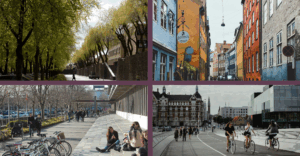
On his first day in Copenhagen, Carson Muscat noticed something distinctly Danish about how people work together. Meetings felt more like conversations than briefings, and everyone seemed to know not just their task but their shared goal. It was, he later wrote, a lesson in how collaboration can become a national habit.
When Stanford master’s student Carson Muscat arrived in Denmark for a summer internship with INNO-CCUS and the Danish Energy Agency, he brought with him several years of experience in the energy industry, having worked on large-scale energy projects before starting his graduate studies. He wanted to understand how a small country had managed to build an entire carbon capture, utilization, and storage (CCUS) sector almost from scratch. Three months later, after interviews across research institutions, ministries, and industry partners, he left with a clear impression: Denmark’s strength lies in its collaboration – and in the quiet determination to move forward together.
That collaboration has brought Denmark – where CO₂ storage was actually prohibited until 2020 – from a ban on CO₂ storage to a leading role in European CCUS development in less than five years. But Muscat’s analysis also points to where the next steps are needed if the country is to maintain its pace.
Keeping society in the loop
The next chapter of Denmark’s CCUS journey is moving from distant offshore platforms to familiar landscapes – bringing carbon storage closer to everyday life and into the view of local communities.
The next phase of Denmark’s CCUS story will play out closer to home. With onshore storage exploration licences granted, we are coming closer to establishing CO2 storage closer to our homes. Muscat notes that public trust and engagement will be just as critical as technical progress.
He highlights the Society and Systems Analysis workstream within INNO-CCUS as a key opportunity to better understand how people perceive CCUS, how dialogue can be strengthened, and how benefits can be shared locally. “The technical progress is impressive,” he says, “but the success of the coming decade will depend on how well society is brought along.”
New partnerships for a new phase
Muscat sees this as essential for bridging the gap from lower TRL levels to commercial deployment.
As projects move from demonstration to full-scale deployment, Denmark’s collaborative model must widen its circle. Muscat observes that while cooperation among research, policy, and industry is well established, financial partners are still missing from many of the conversations. Involving investors, infrastructure funds, and green financiers earlier, he suggests, could help bridge the gap between research breakthroughs and market-ready solutions.
Balancing a growing ecosystem
With more than 30 projects already supported and many more emerging, INNO-CCUS is entering a new phase of growth. Muscat recommends a more systematic approach to tracking and evaluating projects – not just by their technical focus but by their impact and connection to each other. By monitoring the ecosystem as a whole, Denmark can ensure that lessons learned are shared and that new initiatives reinforce, rather than duplicate, existing work.
A culture worth keeping
In his reflections, Muscat contrasts Denmark’s integrated CCUS model with the more fragmented approaches he has observed in other countries, such as the United States, where coordination often depends on market forces rather than mission-driven collaboration.
Muscat’s reflections capture something that has long been recognised within Denmark’s green transition: collaboration here is not just coordination – it is culture. From ministries to research labs and industrial sites, he found a shared sense of purpose that accelerates progress.
“Denmark’s success lies in how people across sectors share goals and learn together,” Muscat says. “The challenge now is to keep that collaboration dynamic as CCUS moves from planning to large-scale execution.”
About the study
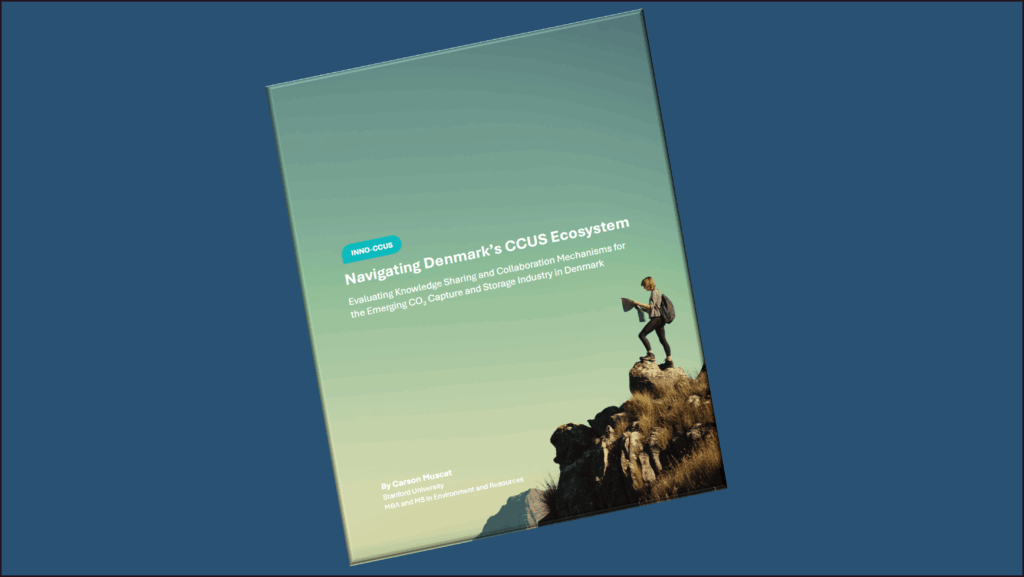
The report “Navigating Denmark’s CCUS Ecosystem” was conducted by Carson Muscat, MBA/MS candidate at Stanford University, during his internship with INNO-CCUS and the Danish Energy Agency in summer 2025. The project was supported by the Stanford Social Management Immersion Fund.